
Rusk County Property Value Types
Rusk County's parcel results carry a "Market Value" label. A separate "Base Tax Due" column sits beside it. Wisconsin DOR defines the neighboring terms too. Its pages cover assessed value, fair market value, the assessment ratio, the municipal assessment level, and equalized value. A recorded deed still documents a conveyance. No sale-price field appears on the parcel result. The deed vendor displays no current transfer amount.
| Value type | What it means | Where it is recorded |
|---|---|---|
| Assessed value | Value assigned under Wisconsin assessment rules for local taxation. | Local assessment roll; the exact parcel card fields were not captured. |
| Market value | Full value that could ordinarily be obtained at private sale under state law. | Catalis result uses the label “Market Value.” |
| Equalized value | DOR municipal measure used to compare assessed totals with equalized totals. | Annual DOR municipal reports. |
| Sale or consideration price | Amount connected to a transfer, if recorded or shown by an instrument. | Deed or transfer record; a parcel-result field was not verified. |
An assessment ratio measures a single parcel. It compares that parcel's assessed value with its fair-market value. A municipal assessment level takes the wider view. It compares aggregate assessed value with equalized value. A deed price and the roll can differ because one is a transaction and the other an assessment record, so neither figure alone is a current appraisal of a Rusk County property.
Find a Rusk County Value Record
The county tax portal offers several search paths. Search by address, owner name, Owner ID, property ID, or a legal clue. A result shows Market Value and Base Tax Due. Copy more than the value. Record the municipality and parcel identifiers too, because DOR reports aggregate data by municipality and the local assessor in Rusk County controls the assessment review process.
- Search the address, owner, or parcel clue in the county Catalis portal.
- Record the Market Value and Base Tax Due labels, tax year, Parcel ID, and legal description shown.
- Ask the local assessor which assessed value and roll year apply to the parcel; the portal sample review did not capture every value field.
- Use the deed index for a recorded transfer, then compare its date and land description rather than assuming the sale price appears on the tax card.
- Assessed value
- A parcel's value under local assessment rules.
- Market value
- Value tied to what could ordinarily be obtained at private sale, not a guaranteed offer.
- Assessment ratio
- Assessed value divided by fair-market value for an individual parcel.
- Assessment level
- Aggregate assessed value compared with municipal equalized value.
- Revaluation
- A reset of assessment relationships as of January 1.
What Rusk County Property Value Cannot Prove
An assessment is not a sale offer, a price guarantee, or a licensed appraisal. A value in the Rusk County tax roll can reflect an assessment cycle rather than today's private-sale market. DOR values property at full value for assessment. Read local ratios with their definitions. Municipal totals deserve the same care.
Value is not price. The Rusk County assessment and market-value fields do not predict what a buyer will pay. For a transaction decision, use current market evidence and a qualified appraisal.
Rusk County Market Value Field
The portal's result inventory shows a Market Value column. It also shows Base Tax Due. Those two fields are not a value calculation. The screen does not display the assessment year, land-versus-improvement split, exemption, value history, or a last-sale field for a sample parcel card. Confirm the current labels and year in the live result before comparing Rusk County properties.
Portal terms warn that data may be third-party, incomplete, or inaccurate. For valuation questions, contact the local assessor or read DOR's explanations of full value and assessment. For an ownership transfer, use the Register of Deeds. The value column is not a deed index.
Rusk County Assessment Ratio and Level
Wisconsin DOR separates two ideas. A parcel's ratio compares its assessed value with its fair-market value. The municipal level is different. It compares the community's aggregate assessed total with its equalized value. One measures a parcel. The other measures a community. Mixing them can make a countywide report look like an individual home estimate.
The DOR municipal ratio reports publish annual value statistics for that purpose. The report page shows municipal figures, not parcel cards.
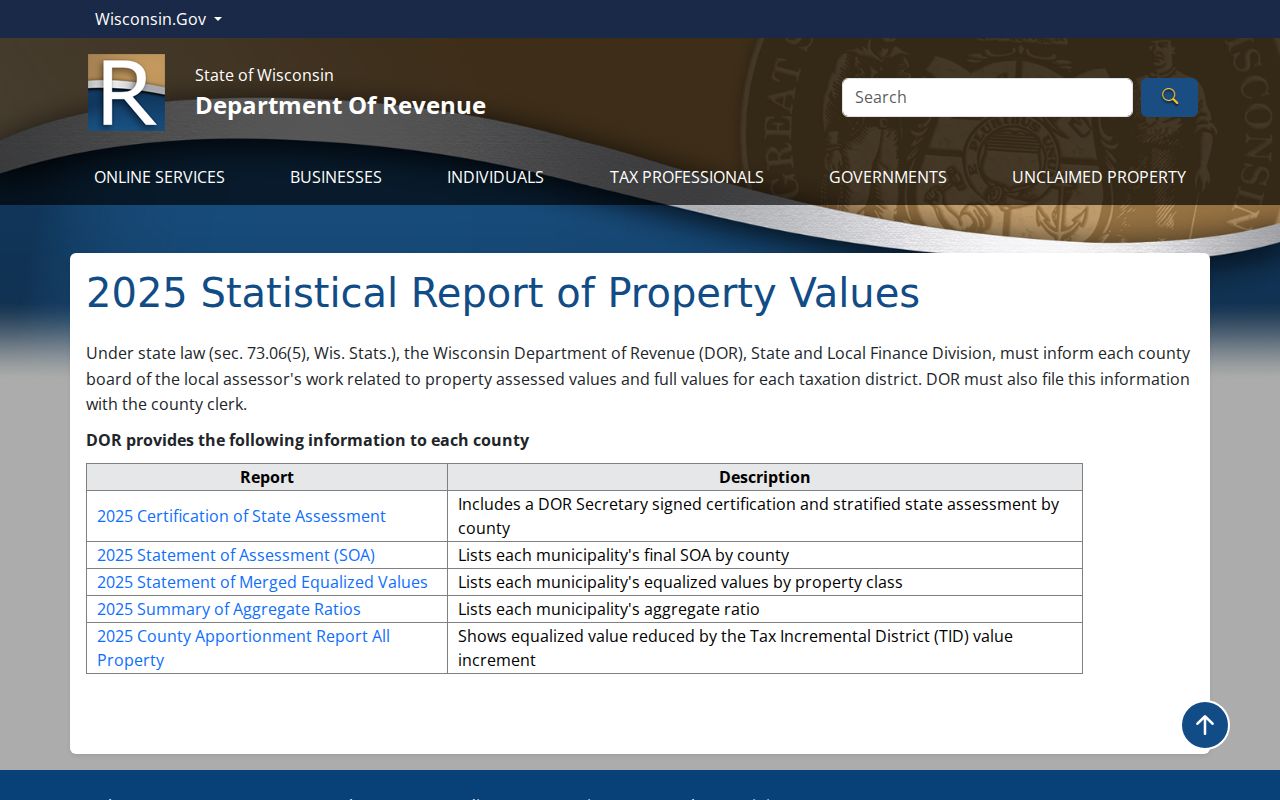
Use the municipal ratio for context. Then ask the local assessor about the parcel's roll.
Before comparing numbers, identify the parcel, municipality, assessment year, and kind of value shown. The county portal's result confirms a "Market Value" label, but the screen does not show its year, a land-and-improvement breakdown, or a change history. Assume nothing about the label. If the year or definition is missing, ask the local assessor what roll entry the figure represents. Definitions matter more than labels here. A portal label and a DOR report may not use the same period or unit.
When supporting assessment material is not online, a Wisconsin public-records request can name the parcel ID, legal description, assessment year, and record sought. State law directs a custodian to respond as soon as practicable and without delay. No single deadline applies to every request. Ask whether inspection is available before requesting copies. Request a cost estimate when charges may apply. A roll document explains the public assessment record in Rusk County. It does not turn the result into an appraisal.
Rusk County Equalized Value Reports
Equalized value is a DOR measure for municipalities and counties, not an estimate of one parcel's sale price. On July 31, 2026, DOR posted preliminary 2026 equalized values, TID values, and county apportionment reports. Municipal changes relied on assessment reports received by the June deadline. Those reports give context for public-finance comparisons. They are not an appraisal for anyone.
When comparing numbers, confirm the municipality. Check whether the DOR report is preliminary or final. The parcel's assessment, the municipality's equalized total, and the county's apportionment answer different questions about a Rusk County property.
Rusk County Revaluation Cycle
Wisconsin does not require every municipality to revalue every year. A revaluation resets relationships as of January 1, while market shifts and maintenance adjustments can alter the roll between revaluations. The research did not locate Rusk County's last local revaluation year or a fast-appreciating district, so neither should be guessed.
Ask the local assessor for the municipality's revaluation history, the date tied to the assessment, and the current Open Book and Board of Review schedule. The county roll can help locate the parcel, while the municipal assessor explains the value process.
Rusk County Recorded Sale Prices
The Catalis parcel result shows no last-sale price field. The transfer-tax details in Tapestry and RODdirect stay unclear. A recorded deed names the parties and describes the conveyance. It may not display a consideration amount at all. A deed search in Rusk County will not always surface a sale price. Promising one would mislead.
When the price matters, find the recorded instrument. Ask the Register of Deeds what the public copy shows. Then compare the recording date and legal description against the assessment record. Keep the three pieces separate. A deed, a tax assessment, and a price estimate each answer a different question.
Rusk County Taxable Value Boundaries
A tax bill reflects more than assessed value. Credits and local tax rates both shape the final number in Rusk County. The Treasurer administers the lottery credit and posts current forms and FAQs. The parcel result lists no exemptions, though. The precise effect of any credit belongs on the tax page. The rest sits in the applicable municipal records rather than in a market-value comparison.
For the tax bill, credits, delinquency, or an assessment review, use the Rusk County property tax record sources. A value lookup should end at what the numbers mean and where each one appears.